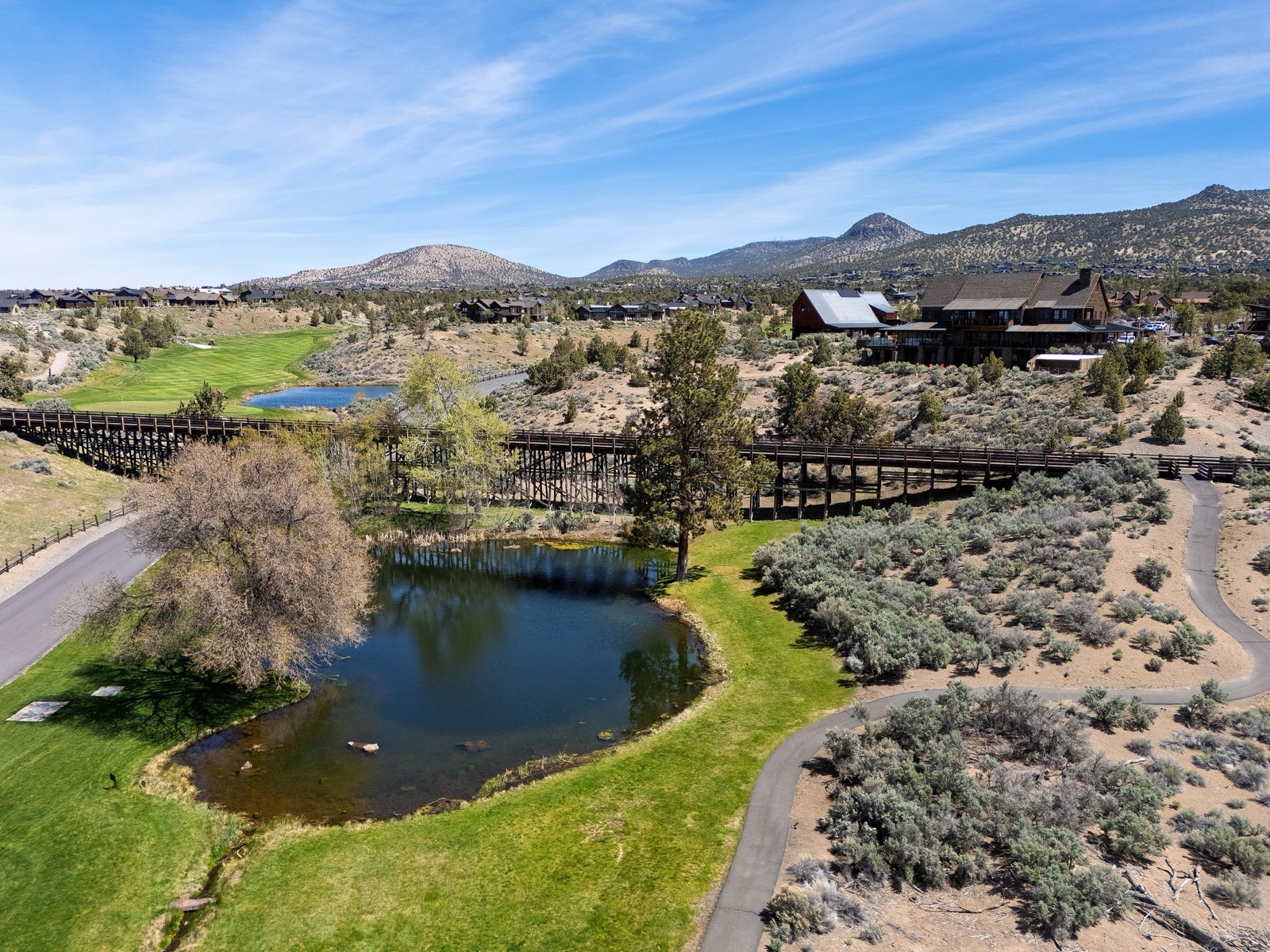
Condo dues at Mt. Bachelor Village run $620 a month across 69 reporting listings. What that covers, how the rental program works, and what to ask before you offer.
Browse Mt Bachelor Village homes for sale.
Mt. Bachelor Village sits where SW Century Drive leaves town and starts to climb toward the mountain, with 239 condominiums built between 1974 and 1994 stacked above a bend in the Deschutes River. It is one of the few Bend addresses built to be a resort first and a neighborhood second, and that shows up in almost every question a buyer asks about it. This guide answers the ones we hear most, with real numbers where we have them and a plain admission where we do not. You can see what is currently listed at Mt. Bachelor Village any time you want the live picture.
What do the HOA dues at Mt. Bachelor Village actually cover?
Across the 69 current condominium listings at Mt. Bachelor Village that report a number, the median HOA due is $620 a month, or $7,440 a year. That is high for a Bend condo, and it should be. This is not a standard HOA maintaining a roof and a strip of lawn. It is a resort HOA, and the dues carry resort-scale grounds keeping, exterior maintenance on buildings that are now 30 to 50 years old, insurance on riverfront property, and upkeep of the common areas and trail that make the address worth having. We do not have a published, line-item budget showing exactly how that $620 splits between operating costs and reserves, so treat that as an open question, not a settled fact. Ask the HOA for its current budget and reserve study before you write an offer, not after.
Is it a condo, or one of the few houses?
Almost everyone who buys here buys a condominium. Out of 239 condominiums, the detached side of Mt. Bachelor Village totals only 5 homes in our data, and none of the 5 currently report HOA dues, which tells you how small and how different that slice of the community really is. If a detached home comes up, treat it as its own conversation, not a smaller version of the condo math above. A five-home segment does not behave like a market, and we are not going to force a trend line onto it. For nearly every buyer, the real decision at Mt. Bachelor Village is which building and which view, not condo versus house.
How does the rental program work, and what are the rules?
Mt. Bachelor Village was built to be rented. Brooks Resources, the Bend developer that opened the resort in 1974 on 170 acres along the river, sold the original condominiums as fractional and whole-interest ownership, "with the ability for the owners to put their unit in the rental program to accommodate overnight guests as inventory allowed," in the developer's own words, published on its community history page. Today the on-site rental operation runs as Mt. Bachelor Village Lodging, described on the resort's own site as the exclusive on-site manager offering direct booking with resort amenities included. The resort itself changed hands in 2018, when Oksenholt Companies bought it from Brooks Resources after more than four decades of ownership, but that sale was of the resort's operating business, not of individual condominium units or the HOA. Owning here means owning into a working resort: expect turnover, cleaning crews, and guests who do not know your unit number from anyone else's. If a quiet building matters to you, ask on your tour which wings see the least rental traffic, and ask specifically what it takes to enroll or withdraw a unit from the rental program, since that is a resort decision, not an HOA one.
Is Mt. Bachelor Village better as a second home or a full-time address?
Both work here, and the ownership split above is a lot of why. A full-time owner gets a river-adjacent address a short drive from downtown Bend without the upkeep of a detached home. A second-home owner gets a unit that can sit in the rental program and earn something when it is empty. What does not work as well is expecting the quiet, low-traffic feel of a standard subdivision HOA. This is a resort with a working rental program built into its foundation, and the dues, the guest traffic, and the building age all trace back to that one fact. Decide which of those two owners you are before you tour, because the same unit reads very differently depending on the answer.
What's the river trail actually like?
The resort's own nature trail runs 2.2 miles, described on its amenities page as "pristine wilderness, brimming with wildlife and breathtaking scenery," looping along the ridge above the Deschutes River. It connects into Bend's broader Deschutes River Trail system, so you can walk or run well past the resort's own loop without getting in a car. For a buyer who wants river access and a trail out the door as much as square footage, this is the amenity that delivers every single day, more reliably than the pool does. The same page notes a seasonal outdoor pool, open Memorial Day through September, and a year-round outdoor jacuzzi, plus EV charging on site, all resort-wide draws rather than line items we can trace to a specific dues dollar.
Does winter close the road to Mt. Bachelor Village?
Century Drive becomes the Cascade Lakes Scenic Byway once it climbs past town, and the stretch of that route beyond Mt. Bachelor closes to cars every winter, typically December through March, according to the route's own record. Mt. Bachelor Village sits close enough to town that the closure does not touch your daily access. It affects the highway further out, past the mountain, not the drive between the resort and Bend. What winter here does mean is a real one: expect snow on the grounds and the walk to your car, and do not assume every "Century Drive winter closure" headline you see is about your own street. Usually it is not.
How is the HOA structured, and who runs it?
The Mt. Bachelor Village HOA is managed by Aperion Management Group, a professional HOA management company, according to the HOA's own page on the resort's site. That is worth knowing going in. A managed association usually means steadier collections and cleaner records than an informal, owner-run board, but budget and reserve decisions still get made by a board working through that manager, not by a vote at the mailbox. Ask for the last two years of board minutes and the current reserve study before you close. That is the fastest way to see whether the $620 median due is keeping pace with a resort this age, or falling behind it.
What does it mean that most buildings are 30 to 50 years old?
Most of the condominiums at Mt. Bachelor Village were built between 1974 and 1994, across 239 units, so the newest are already past 30 years old and the oldest are past 50. That is not a red flag by itself. Plenty of well-run associations keep buildings that age in excellent condition. But it does change what you check before you buy. Roofs, siding, decks, plumbing, and pool equipment all have a finite life, and on a building this age you want documentation of what has been replaced and what is original, not an assumption from the listing photos. This is exactly what a reserve study is for, and it is a real part of why dues here run well above a newer Bend building.
How far is it really to downtown Bend and to Mt. Bachelor?
The resort's address, 19717 SW Mount Bachelor Dr, sits close enough to town that the resort's own site markets it as "just minutes from Mt. Bachelor and downtown Bend," and puts the drive to Mt. Bachelor Ski Area at about 30 minutes. That is the trade this location makes. You give up being in the middle of downtown for being on the road that leads straight to the mountain, with the river and a trail system in between. For a buyer cross-shopping this against a downtown condo or a house on Awbrey Butte, that is the real comparison to run: drive time to the mountain against walk time to a coffee shop, not price per square foot.
How do lenders treat a condo in a resort like this?
Financing a condo inside a resort is its own conversation with a lender, and it is worth having early, before you fall for a specific unit. In general, lenders look at a building's owner-occupancy ratio, how much of its budget goes to reserves, whether any single owner or entity holds an outsized share of units, and whether the HOA carries adequate insurance. A building that leans heavily toward short-term rentals or carries fractional-ownership units can trip a lender's warrantability rules in ways a standard subdivision condo never does. None of that is unique to Mt. Bachelor Village. It is true of resort condos generally. It does mean your pre-approval for "a condo" is not automatically good for this condo. Get your lender the HOA questionnaire and current budget before you are under contract, not during your inspection period.
What should you ask before you make an offer?
- Ask for the current reserve study and the last HOA budget, and compare the reserve balance to the age of the roofs and decks.
- Ask whether the unit is currently enrolled in the rental program, and what it actually takes to enroll or withdraw one.
- Ask your lender to run the HOA questionnaire on this specific building before you write, not after you are under contract.
- Ask for two years of board minutes, not just the current budget, so you can see how the board has handled past repairs.
- Walk the grounds and the trail at the time of day you would actually use them, not only during a scheduled showing.
Questions
How much are HOA dues at Mt. Bachelor Village?
The median is $620 a month, or $7,440 a year, from the 69 current condominium listings that report a number. That figure is specific to condominiums. The small number of detached homes on the property do not report dues.
Are there houses for sale at Mt. Bachelor Village, or only condos?
Mostly condos. The community totals only 5 detached homes against 239 condominiums, and none of the 5 currently report HOA dues in our data. Nearly every buyer here is choosing between condominium buildings, not between a condo and a house.
Can I rent out my unit at Mt. Bachelor Village?
Yes, that is part of how the resort was built. The original developer sold units as fractional and whole-interest ownership with the ability to place them in a rental program, and today that program runs as Mt. Bachelor Village Lodging, the resort's own on-site manager. Ask what it takes to enroll or withdraw a specific unit before you buy it.
How old are the buildings at Mt. Bachelor Village?
Most of the 239 condominiums were built between 1974 and 1994. That puts the newest units past 30 years old and the oldest past 50, which is a real factor in the $620 median HOA due and in what you should ask about reserves before you buy.
Does the winter road closure near Mt. Bachelor affect access to the resort?
No. The seasonal closure on the Cascade Lakes Scenic Byway, typically December through March, applies to the stretch of highway past Mt. Bachelor, well beyond the resort. Mt. Bachelor Village keeps normal, year-round access from town.
Where do the numbers in this guide come from?
The HOA dues, unit count, detached-home count, and build years come from our own market data, pulled fresh from the current listing set. The resort's history, ownership, rental program, amenities, and HOA management are drawn from the resort's own website and its developer's published history, with a link to each source above.
Next step
See what is currently listed at Mt. Bachelor Village, or talk to one of the brokers on our team about a specific unit, the rental program, or how a building's reserve study actually looks before you write an offer.