
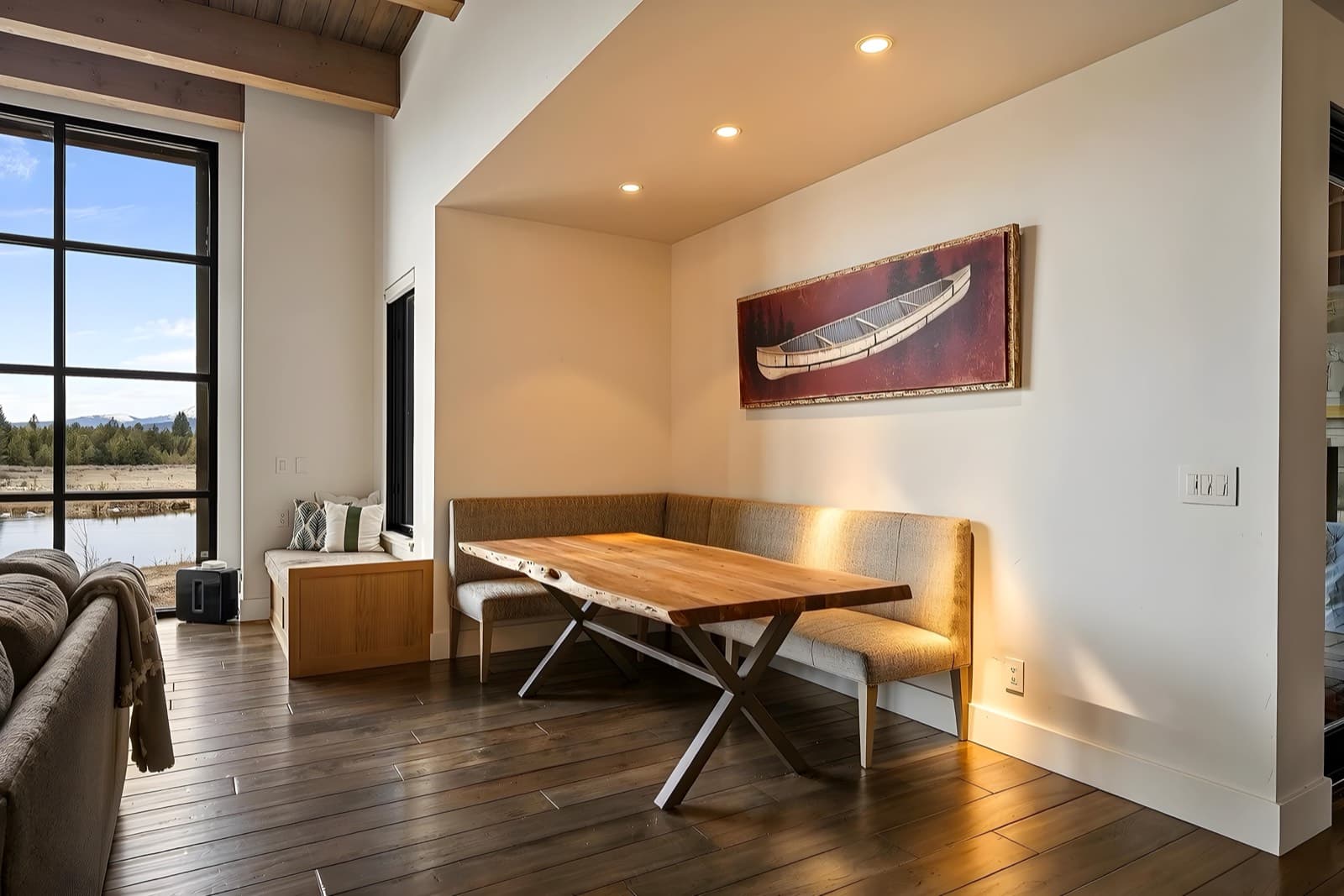
Staging works, and in Central Oregon's market, the specific choices you make when staging matter, because buyers here have particular expectations about how a home should feel.
The data on staging
The National Association of Realtors reports that staged homes sell for 1% to 5% more than unstaged homes and spend 33% to 50% fewer days on market. On a $600,000 Bend home, that 1% to 5% translates to $6,000 to $30,000, more than the cost of a staging investment that typically runs $2,000 to $5,000 for an occupied-home consultation and refresh, or $3,000 to $8,000 for full vacant staging.
The days-on-market difference matters too. Every week your home sits unsold costs you in mortgage payments, insurance, utilities, and stress. A home that sells in 10 days versus 45 days saves you roughly a month of carrying costs, which on a $600,000 home with a $3,500 monthly payment is real money.
Why staging works psychologically
Buyers make emotional decisions and then justify them rationally. Staging creates an emotional response: this feels like a place I could live. An empty room looks smaller than a furnished one. A cluttered room makes buyers think about your stuff instead of imagining theirs. Good staging removes friction and lets buyers focus on the home itself.
Central Oregon style
Staging in Central Oregon is different from staging in Portland or Seattle. Buyers moving to this region have specific lifestyle expectations, and your staging should reinforce them.
The mountain modern aesthetic
The look that works best for Central Oregon buyers blends clean contemporary lines with natural materials. Think warm wood tones, stone accents, leather and linen textiles, and a color palette drawn from the landscape: sage greens, warm grays, deep forest tones, and the sandy tan of high desert. If your home's interior leans this direction, lean into it. If your decor is heavily traditional or coastal, consider swapping out some key pieces.
Windows and outdoor views
Central Oregon buyers are here for the outdoors. If your home has mountain views, clear the window treatments and make sure nothing blocks the sightlines. If you have large windows, make sure they're clean. If your home connects to a patio or deck, stage that transition space so it flows visually. A dining table near a window with a mountain view is worth more than the same table against an interior wall.
Room by room guide
Living Room
The living room sets the tone for the entire home. In Central Oregon, the fireplace is often the focal point. Make sure yours is clean, operational, and staged as a gathering point. Remove any furniture that makes the room feel cramped: if you have to turn sideways to walk through the room, there's too much furniture.
- Clear surfaces to no more than three items per horizontal space
- Add texture through throw blankets and pillows in natural tones
- Position furniture to create conversation areas, not theater-style rows facing the TV
- If the room has great natural light, show it off with sheer or no window treatments
- Remove personal photos and replace with landscape art or large-scale abstract pieces in neutral tones
Kitchen
Clear every counter of small appliances except the ones that look high-end (a coffee maker and a stand mixer can stay). Everything else goes in a cabinet or into storage.
- Clear the refrigerator of magnets, calendars, and kid art
- Replace dish soap and hand soap with matching bottles in a neutral design
- Add a bowl of fresh fruit or a small herb plant as your one counter accent
- Make sure cabinet hardware is uniform and contemporary (swap mismatched or dated knobs for about $3 to $5 each)
- Deep clean the oven, cooktop, and sink
- If cabinets are dark and dated, painting them is a high-return investment (typically $3,000 to $6,000 for a professional job)
Primary Bedroom
This room should feel calm and spacious, without being so perfect that it feels unlivable.
- Invest in a clean, coordinated bedding set in white or neutral tones
- Remove all furniture except the bed, nightstands, and one dresser if the room can handle it
- Clear nightstands to one lamp and one small item each
- Add a throw blanket at the foot of the bed
- If the room has an en-suite bathroom, make sure the visual transition is clean
Bathrooms
Bathrooms need to feel spotless. That's the baseline. Beyond clean, think hotel bathroom.
- Replace old shower curtains with a clean white one or remove if you have glass doors
- Roll white towels on the counter or hang matching towels on bars
- Remove all personal toiletries from view
- Re-caulk any stained or cracked caulk lines around the tub, shower, and toilet base
- Replace an old toilet seat for $20 to $40 if it's stained or scratched
Secondary Bedrooms
Each bedroom should have a clear purpose. If you've been using a bedroom as a catch-all storage room, it needs to look like a bedroom again. A bed, a nightstand, and a lamp are the minimum. If the room is small, a twin bed can make it look larger than a queen.
Home Office
Since the remote work migration to Bend, a staged home office appeals to buyers. If you have a room that could serve as an office, stage it as one: a clean desk, a comfortable chair, good lighting, and a view out the window. Many buyers in Bend are remote workers relocating from larger metros.
Outdoor spaces
In Central Oregon, outdoor living space is not a bonus feature. It's a primary consideration for most buyers. Staging your outdoor spaces is as important as staging the interior.
Deck and Patio
- Power wash the deck. Cost: $200 to $400 for a professional service, or rent a power washer for $75 a day.
- Stage with clean outdoor furniture arranged for conversation, not storage. A table with four chairs, a couple of Adirondack chairs, or a small seating area with a fire pit.
- Add a few potted plants that look at home in high desert (drought-tolerant grasses, lavender, or succulents).
- If the deck has a mountain view, make sure nothing blocks it. Raise or remove any railing planters that obstruct sightlines.
Yard and Landscaping
Central Oregon landscaping isn't about lush green lawns, given water considerations. Buyers expect tidy, drought-appropriate landscaping with native plants, well-maintained bark dust or gravel, and clean edges.
- Trim all bushes and trees, especially anything touching or overhanging the house
- Refresh bark dust or decorative rock in beds ($200 to $500 for most properties)
- Repair any broken fence sections or leaning posts
- Clean up any stored firewood, spare building materials, or accumulated outdoor items
- If you have an irrigation system, make sure it's operational and set to run during the listing period
Winter Considerations
If you're listing during Central Oregon's cold months (November through March), staging the exterior takes different effort. Keep walkways and driveways clear of snow and ice. Make sure exterior lighting works so the home looks inviting during early dark evenings. A small wreath on the front door is fine, but avoid heavy holiday decorations that date the listing photos and make it harder for buyers to imagine the home as theirs.
Photography prep
Staging isn't done until the photographer has captured it. Schedule your photography session for the best possible light, which in Central Oregon typically means mid-morning or late afternoon when the sun is at a lower angle and creates warmth without harsh shadows.
- Turn on all interior lights, including lamps, for photography
- Open all blinds and curtains
- Remove all cars from the driveway and visible areas
- Put away trash cans, garden hoses, and pet items
- If you have mountain views, schedule the shoot for a clear day (Bend averages 158 sunny days and 100 partly cloudy days per year, so you'll have options)
Virtual staging
For vacant homes where full staging isn't in the budget, virtual staging is a viable alternative. A designer digitally adds furniture and decor to photos of empty rooms. The cost is typically $100 to $300 per image, a fraction of physical staging.
Virtual staging works best when it's realistic and clearly labeled. Buyers expect to see an empty home when they visit, and feeling misled is worse than seeing empty rooms in photos. Use virtual staging to show the potential of a space, not to deceive. Always disclose in the listing that photos are virtually staged.
Budget staging
If you're working with a limited budget, focus your effort and money where it has the most impact:
- Deep clean everything: $300 to $800 for professional cleaning. This has one of the highest returns of any staging investment.
- Declutter ruthlessly: Remove 50% of what's on shelves, counters, and visible surfaces. Free.
- Fresh white towels for every bathroom: $50 to $100.
- New coordinated bedding for the primary bedroom: $100 to $200.
- A few potted plants for the entry and living areas: $50 to $100.
- New front door mat and house numbers: $30 to $60.
Total budget staging cost: under $1,000. Expected impact on a $500,000 home: $5,000 to $25,000 in additional sale price and a faster sale.
What not to do
Some staging advice is counterproductive. Avoid these common mistakes:
- Don't over-stage. A home that looks like a furniture showroom feels impersonal and staged. Buyers can tell. Leave some breathing room.
- Don't use strong scents. Scented candles, plug-in air fresheners, and baking cookies before showings are all cliches that make buyers wonder what smell you're trying to cover up. Clean and neutral is the goal.
- Don't block architectural features. If you have exposed beams, large windows, or built-in shelving, don't obscure them with furniture or heavy decor.
- Don't forget the garage. Central Oregon buyers use their garages for skis, bikes, kayaks, and other gear. A clean, organized garage that shows plenty of room for outdoor equipment is a selling point. A cluttered garage makes the whole house feel smaller.
- Don't try to hide problems. Staging over a stain, strategically placing furniture to cover damaged flooring, or painting over water damage will come out during inspection and destroy buyer trust.
Staging for different price points
The staging approach should match buyer expectations at your price point.
Homes Under $450,000
Buyers in this range are often first-time homeowners or investors. They're practical and budget-conscious. Focus staging efforts on showing the home is well-maintained and move-in ready. Clean, declutter, and fix visible issues. Professional staging with rental furniture is usually overkill. A consultation with a stager plus your own execution is usually enough.
Homes $450,000 to $750,000
This is the heart of the Bend market, and buyer expectations are higher. Professional photography is essential, and partial staging of key rooms (living room, primary bedroom, kitchen) often pays for itself. Buyers at this level are comparing your home against a dozen others in the same range. Presentation separates the homes that get multiple offers from those that sit.
Homes Over $750,000
Full professional staging with high-quality rental furniture is usually worth the cost. Buyers spending over $750,000 in Central Oregon are comparing your home not just to other listings, but to the lifestyle they're imagining for themselves.
Working with a professional stager
If your budget allows, a professional stager can be worth the cost. In Central Oregon, a staging consultation (where the stager walks your home and gives you a detailed to-do list) costs $200 to $500. Full staging with rental furniture runs $3,000 to $8,000 for a 60-day period depending on the home's size.
A good stager knows which pieces and arrangements photograph well and appeal to the buyer demographic for your price point. For homes over $700,000, professional staging is almost always worth it. For homes under $400,000, a consultation plus DIY execution usually makes more financial sense.
When interviewing stagers, ask to see before-and-after photos of homes they've staged in Central Oregon specifically. Staging sensibility varies by region, and someone experienced with the local aesthetic will make better choices than a stager who primarily works in Portland or Eugene.
What actually helps a home sell
Staging removes the distractions that keep buyers from seeing the home clearly. Clear the clutter, clean thoroughly, and make sure the outdoor living areas reflect the Central Oregon lifestyle. For a more detailed pre-listing timeline, check our seller resources or get a free valuation to see where your home stands in the current market.