




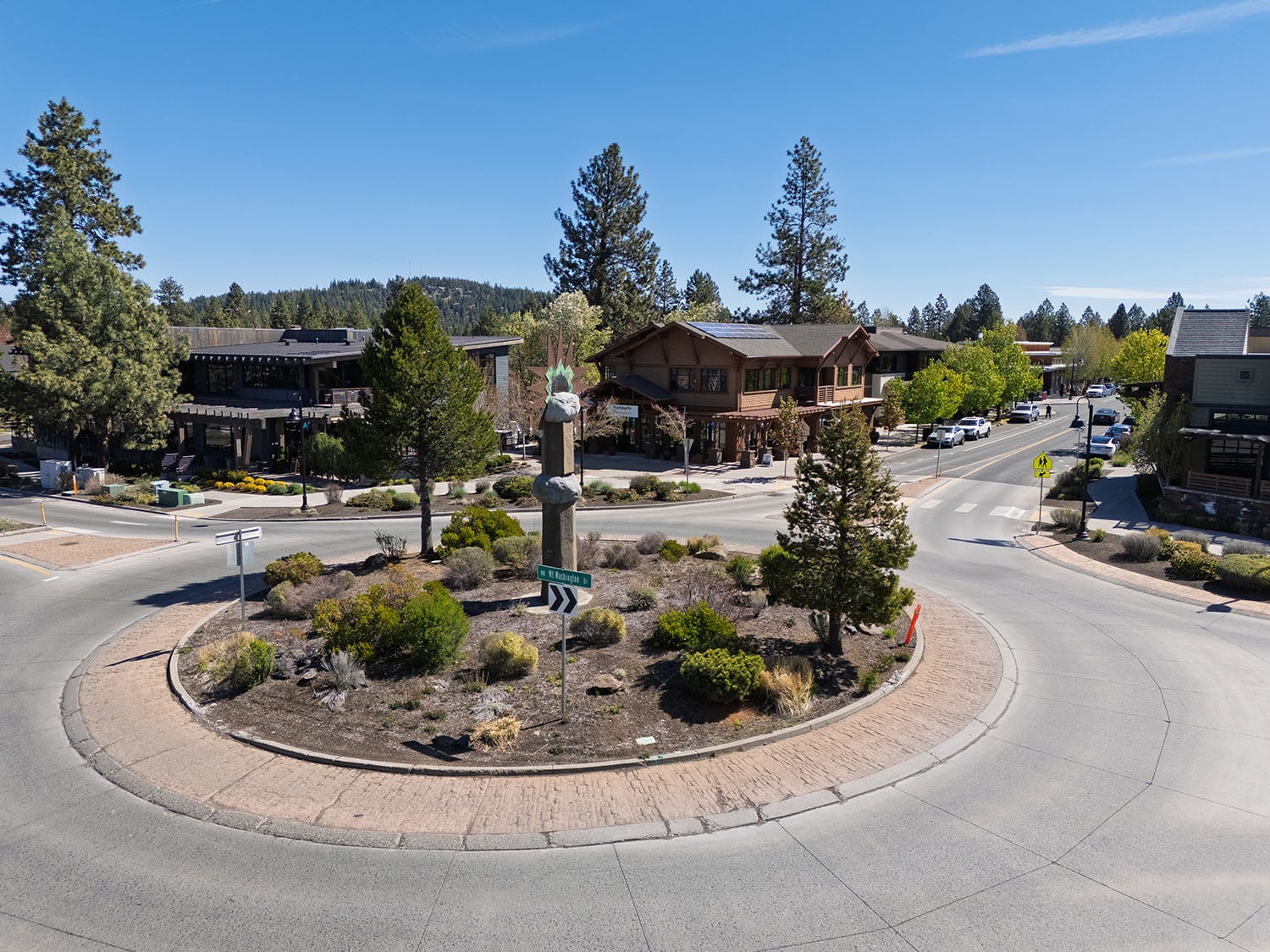
NW Crossing occupies an unusual position in Bend’s real estate landscape. In a city built around the car, this west-side neighborhood was designed from the start around walkability, something that sounds obvious until you realize how rare it actually is in Central Oregon. If you have been searching for a place where your daily errands do not require a fifteen-minute drive, NW Crossing deserves a serious look, and this guide will give you the unvarnished details.
Location and Layout
NW Crossing sits on Bend’s west side, roughly bounded by Skyliners Road to the north and Mt. Washington Drive to the south. The neighborhood is about a ten-minute drive from downtown Bend and five minutes from the Cascade Lakes Highway, which puts you within easy reach of Mt. Bachelor, Todd Lake, and the Deschutes National Forest trail system.
The development was designed as a New Urbanist community, meaning homes are closer together than typical Central Oregon subdivisions, streets have sidewalks on both sides, and there is a commercial village center baked into the plan rather than bolted on as an afterthought. The result is a neighborhood that feels more like a small Pacific Northwest town than a standard subdivision.
The west-side location also means you are on the “mountain side” of Bend. Elevation is slightly higher than the east side, which brings a bit more snow in winter and slightly cooler summer evenings. Sunsets behind the Cascades are a daily event that long-time residents still notice, which says something.
The Village Center and Walkability
The heart of NW Crossing is its village, a cluster of shops and restaurants along NW Crossing Drive. You will find Thump Coffee, a small grocery and deli, a pub, a pizza spot, a wine bar, and a handful of other businesses. The business mix rotates occasionally, but the core tenants have been stable for years. It is not a full downtown, but it covers the daily essentials without a car trip.
Several parks are woven through the neighborhood, connected by paved paths. Discovery Park is the largest, with play structures, open fields, and a community gathering area. The path system also connects to Bend’s larger trail network, so you can bike or walk to other parts of the west side without riding along major roads. In summer, you will see people commuting to coffee on foot, kids riding bikes to friends’ houses, and dog walkers on every path. In winter, the paths are cleared but see less traffic; the village still functions as a walking destination year-round.
For families, the walkability extends to schools. NW Crossing is zoned for Elk Meadow Elementary and Cascade Middle School, both within reasonable walking or biking distance for older kids. High school students attend Summit High, which is a short drive or bus ride away.
Home Styles and Architecture
NW Crossing has a distinct architectural identity compared to much of Bend. The design guidelines favor Craftsman, Northwest Contemporary, and cottage-style homes. You will not find the stucco-and-tile look common in some of Bend’s newer east-side developments. Homes tend to feature covered front porches, natural materials like stone and wood siding, and muted earth-tone color palettes. The architectural coherence gives the neighborhood a visual identity that is recognizable even to people who do not know Bend well, and it contributes to the property value stability discussed below.
Lot sizes are notably smaller than the Central Oregon norm, typically ranging from 3,000 to 7,000 square feet. If you are coming from a place where quarter-acre lots are standard, this will feel compact. The trade-off is that the community common spaces, parks, and paths make up for smaller private yards. Many homeowners find they use the neighborhood parks more than they expected and their yards less.
Home sizes range from around 1,200 square feet for smaller cottages up to about 3,200 square feet for larger single-family homes. There are also townhouses and attached homes in the mix, which provide lower entry points into the neighborhood. Garages are typically two-car, which is worth noting because storage space matters in Central Oregon, between ski gear, bikes, kayaks, and the other equipment that comes with living here.
Price Ranges and Market Trends
NW Crossing commands a premium for its walkability and design. As of recent sales data, expect the following ranges:
- Townhouses and attached homes: $475,000 to $650,000
- Smaller single-family homes (under 1,800 sq ft): $600,000 to $800,000
- Larger single-family homes (1,800 to 3,200 sq ft): $800,000 to $1,200,000
- Premium lots or custom builds: $1,000,000 and up
These prices are higher per square foot than many other Bend neighborhoods, and that premium has been consistent. NW Crossing homes tend to hold value well and sell quickly because the supply of walkable neighborhoods in Bend is essentially fixed. You cannot replicate the neighborhood’s location and design elsewhere in town, which gives it a structural pricing advantage.
Check current Bend listings to see what is available right now, or visit our Central Oregon market data for broader pricing trends.
HOA and Community Rules
NW Crossing has an active homeowners association that manages the common areas, parks, paths, and architectural review process. Monthly dues typically run between $100 and $175 depending on the sub-area within the development. These cover landscape maintenance in common areas, path upkeep, and community events.
The architectural review committee enforces design standards, which keeps the neighborhood’s visual coherence intact. If you want to paint your house bright purple or put up a chain-link fence, NW Crossing is not the place. If you appreciate consistent neighborhood aesthetics, this is a feature, not a bug.
Who Lives Here
NW Crossing attracts a mix of demographics, but a few groups are particularly well-represented:
- Young families: The walkability, nearby schools, and parks make this a natural fit for families with kids. You will see strollers and bikes everywhere.
- Active professionals: People who work remotely or have flexible schedules and value being able to walk to coffee or lunch without a commute.
- Downsizers: Some retirees and empty-nesters who want to trade a larger property for a low-maintenance home in a walkable setting.
The community vibe is friendly but not aggressively social. There are neighborhood events throughout the year, including a summer concert series, holiday gatherings, and seasonal farmers market appearances, but nobody is going to knock on your door if you prefer to keep to yourself. It has the feel of people who chose this neighborhood deliberately and appreciate what makes it different.
Practical Considerations
Winter Access
The west side of Bend generally gets more snow than the east side, and NW Crossing is no exception. Streets are plowed, but the neighborhood’s narrower roads can take longer to clear after a significant storm. Four-wheel drive or all-wheel drive is advisable for Central Oregon winters in general.
Traffic and Parking
The smaller lot sizes and narrower streets mean on-street parking can get tight, especially during community events or when residents have guests. If you have more than two cars, garage and driveway space matters. Most homes have two-car garages, but a third vehicle will end up on the street.
Proximity to Recreation
NW Crossing is one of the closest neighborhoods in Bend to the Cascade Lakes corridor. Phil’s Trail, one of Bend’s most popular mountain biking trail systems, is a short drive or a longer bike ride from the neighborhood. Mt. Bachelor is about 25 minutes away. Tumalo Falls is even closer.
Groceries and Services
While the village center covers casual dining and coffee, you will still need to drive for a full grocery run. The nearest large grocery stores (Newport Market, Trader Joe’s, Whole Foods) are about five to ten minutes away. Medical facilities, including St. Charles Bend, are a ten to fifteen minute drive.
Resale and Turnover
NW Crossing homes do not sit on the market long. The neighborhood’s limited size (there are no new phases or expansion areas) and strong demand mean listings typically go under contract within days or a few weeks. This is good news for sellers and a reminder for buyers to be prepared to move quickly. Having your financing in order before homes hit the market is not optional here; it is a practical necessity.
Is NW Crossing Right for You
NW Crossing is a strong fit if you prioritize walkability, appreciate architectural standards, and do not mind smaller lots in exchange for community amenities. It is less ideal if you want acreage, need to keep costs under $500,000, or prefer a more rural Central Oregon feel.
The neighborhood has earned its premium pricing by delivering something genuinely scarce in Bend: a place where you can live your daily life on foot. That is not going away, and neither is the demand for it. If you are thinking about the long game, NW Crossing’s position as one of the only walkable neighborhoods in a car-dependent city gives it a structural advantage that is unlikely to erode.
If you want to explore what is currently for sale in NW Crossing or elsewhere on Bend’s west side, browse available homes or reach out to our team for a conversation about which Bend neighborhoods fit your priorities.